Friday, January 20, 2012

The Animal Chair

The Octopus Chair. Ancient marine life sculpted by modernity.
As soon as I saw this chair, I fell in love with it. The concept behind this modern chair is absolutely incredible. The design, the fabric and materials used, the attention to details make it look alive. It is an elegant and majestic sculptural piece of furniture, one that remains true to the animal’s every detail.
 
The creator of this beautiful piece is Máximo Riera, a practicing spanish artist for over thirty years.

The Octopus Chair is part of The Animal Chair Collection, that constitutes a diverse range of species, from mammals to reptiles, and even including insects. Each creation retains the animal’s natural vitality whilst being totally biological accurate in their appearance. This collection is homage to these animals and the whole animal kingdom which inhabits our planet, as an attempt to reflect and capture the beauty of nature in each living thing.


Over thirty professionals worked on this project, using a CNC milling machine, an internal frame, three-dimensional computer modeling, and expert craftsmanship in order to produce the chair.


The Octopus Chair is the first piece of the Animal Chair collection, and it establishes a base and point of departure for the pieces to come. 2 more pieces are alive: the Walrus Chair and the Rhino Chair which can be seen below, and the Lion Chair, the Beetle Chair and the Whale Chair are in progress. 

The Rhino Chair

The Walrus Chair

“Whilst considering the chair’s basic functionality, I also wanted to bring it alive, make it more present and create a stronger link between the spectator, the piece and the surrounding space,” says the artist.

The artist presented his animal chair collection at 100% design london as part of london design week 2011.


To read more about the artist and his work, please visit his website www.maximoriera.com

Monday, January 16, 2012

Photography

Photography for me is definitely one of those things that “is worth more than a thousand words”.

I haven’t shown my photography to anyone outside school yet, so I thought it would be a great start to take advantage of my blog and upload a few pictures I’ve taken.

In 2008 I took a Photography course, and I have to thank my teacher for making me take hundreds of pictures for every assignment, for being so patient with me and my classmates, and also for explaining the same thing over and over again until we got it.

During the first class, when the teacher started to go over all the terms and techniques, I felt like I would never get to understand photography, but as with everything else, if you like what you do and practice it over and over, in the end, it does pay off.

I love taking pictures as much as I love learning new techniques. At the moment, I have two different photography teachers, and they are both great. One of the things that I have found I really like is working in the photography studio. I don’t know a lot of students that have the ability to work with studio equipment, and I feel I’m really lucky to have this chance and also learn from two of the best.

As you can see below, I enjoy taking pictures in black and white, as well as portraits, architecture and macro micro.


Sunday, January 15, 2012

Design for a Cause

Wallets Illustration

This is another school project that I really enjoyed working on.
The goal was to design two wallets (inside and out) that would go together.

Deciding on a concept was a great challenge. Having the creative freedom to do anything I wanted seemed to work against me when I started the project. But after some great advice from my Illustration teacher - to make a list with things I would like to draw and things that I wouldn’t - I knew exactly what I wanted to do: I decided to do something that was meaningful to me.

I remembered that a couple of years ago I watched “The Cove”, a documentary film that analyzes and questions Japan’s dolphin hunting culture. It was awarded the (2010) Academy Award for Best Documentary Feature. I was really shocked when I first watched the documentary, and a part of me didn’t want to believe something like this happens in the world.

Please take a few minutes to watch the trailer of the documentary as well as a short campaign clip.


My idea for the project was to create a small campaign based on the documentary, that would help bring awareness, and a wallet would work great, as it is something that everyone has with them at all time.

As far as the design goes, at first, I thought that I would need to create something very graphical in order to catch people's attention, and I’m glad that idea wasn’t approved. The final idea was a simple, clean and subtle design, which I think it’s even more effective. On the outside of the wallet I decided to go with an illustration and a quote from the documentary, while on the inside with an abstract pattern created with shapes that give the feel of waves and water.

For the style, I came across Riccardo Guasco, an illustrator, painter and cartoonist, whose style caught my attention from the start, and worked well with what I wanted to do.

This is a project that I would like to continue working on it and expand it. I would like to do a series of illustrations, and furthermore, my goal is to find sponsors that would be willing to support the cause and make these available to the public as wallets, t-shirts, posters, hats, and so on, and donate the profits to the cause.

Below you can see my designs:


How you can help:

How to Apply Gold Leaf

My first attempt to use gold leaf was purely out of curiosity. I’m always excited to work with new materials, and during the first year of school we had a project called “Illuminated Manuscripts”.

 “An illuminated manuscript is a manuscript in which the text is supplemented by the addition of decoration, such as decorated initials, borders (marginalia) and miniature illustrations. An illuminated manuscript is not considered illuminated unless one or many illuminations contained gold foil or was brushed with gold specks, a process known as burnishing. By adding richness and depth to the manuscript, the use of gold in illuminations created pieces of art that are still valued today.” read more

I started by trying to recreate the letter “P” from the “Book of Kells” (“an illuminated manuscript Gospel book in Latin, containing the four Gospels of the New Testament together with various prefatory texts and tables. It was created by Celtic monks ca. 800 or slightly earlier.”)


I had a lot of fun working with gold leaf, so I decided to make a tutorial afterwards.
(*Please note that I made this tutorial based on a few other tutorials, videos and articles I have read on this subject, as well as my “letter P” experiment. It is just the technique I had used, and I’m sure there are lots of other techniques out there.)

How to Apply Gold Leaf
Step 1: What you need
You need: your board with the outline of a shape, Gold Leaf, Rubber Cement, Metal Leaf Sealer, Exacto Knife, a small brush, Q-tips, a tissue paper and a cotton pad.

Step 2: Cut/Prepare the Gold Leaf
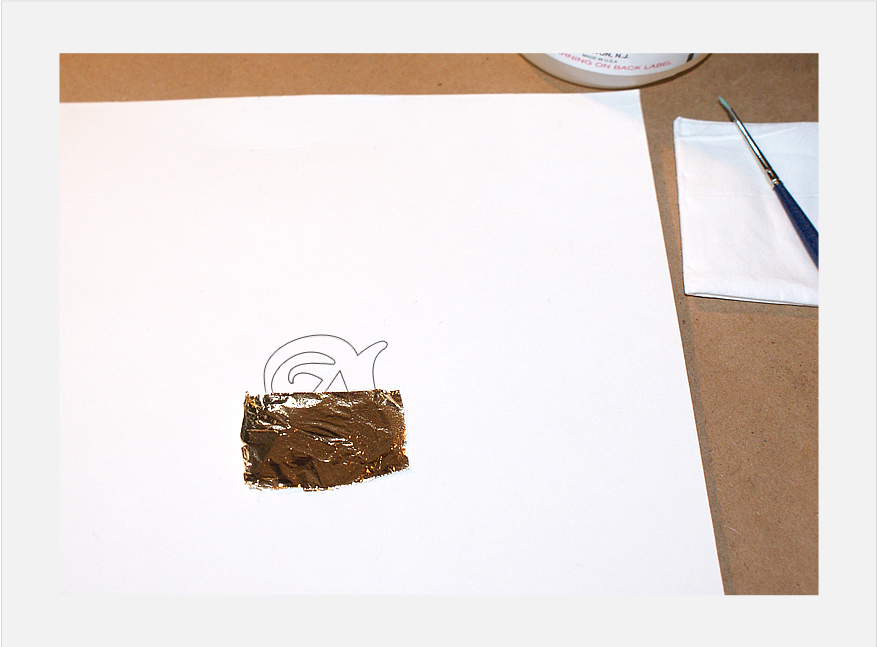
Transfer the Gold Leaf onto a tissue paper and cut it into small pieces. I have found that small pieces are easier to handle, but if you want to cover a larger area, you can cut it into bigger pieces.

Use the Exacto Knife to cut and a cotton pad (or a tissue paper) to hold the Gold Leaf.

Step 3: Apply Gold Leaf
With a small brush apply a thin layer of Rubber Cement (or Metal Leaf Sealer) on your shape where you want the Gold Leaf.

The Metal Leaf Sealer is easier to handle. It doesn’t dry out so fast and it is like watercolour, so you can work with small detail.

It’s up to you how much you want to cover at once.
A) You can cover everything with one leaf (a small shape without too much detail).
B) You can work on one small area at a time (a bigger shape or details).
    * Apply Metal Sealer to one part of the shape, apply Gold Leaf, wait to dry, clean it, and then move to another area OR
    *Apply Metal Sealer to one part of the shape and the Gold Leaf, then apply Metal Sealer and Gold Leaf to another area, and so on until the entire shape is covered. Clean everything at the end.

I prefer to work with one area at a time (and clean it) because I can keep track of how my shape is supposed to look like when I’m cleaning it.

Step 4: Clean Your Shape
Roughly clean the excess of Gold Leaf with a Q-Tip.
Be careful not to go over the shape too many times. That is why I said it is important to remember your shape.

If you crack/rip off the Gold Leaf, you can go back at anytime and apply Metal Leaf Sealer and Gold Leaf over it.

Don’t worry if you can see the line where the Gold Leafs meet. You can hide it with a thin layer of Metal Leaf Sealer in the end. (Step 6)

Here is how my rough shape looks like.

Step 5: Define Your Shape
Take the Exacto Knife and define the shape.

Step 6: Seal the Gold Leaf
Apply GENTLY a thin layer of Metal Leaf Sealer over your final shape. It will set it in place and protect it.

You can use a small or a big brush. I would suggest to use a smaller brush and don’t go over the outline because it will be harder to clean. If you do go over with the sealer, just scrape it off with the Exacto Knife.

(You can always add/repair/change your shape with more layers of Gold Leaf. Just remember to seal it when you’re done).

Congratulations!
You finished your Illuminated shape.
Really easy, very rewarding and a lot of fun.


Below you can also see the "Illuminated Manuscript" project and how it came out.


Paula Nizamas

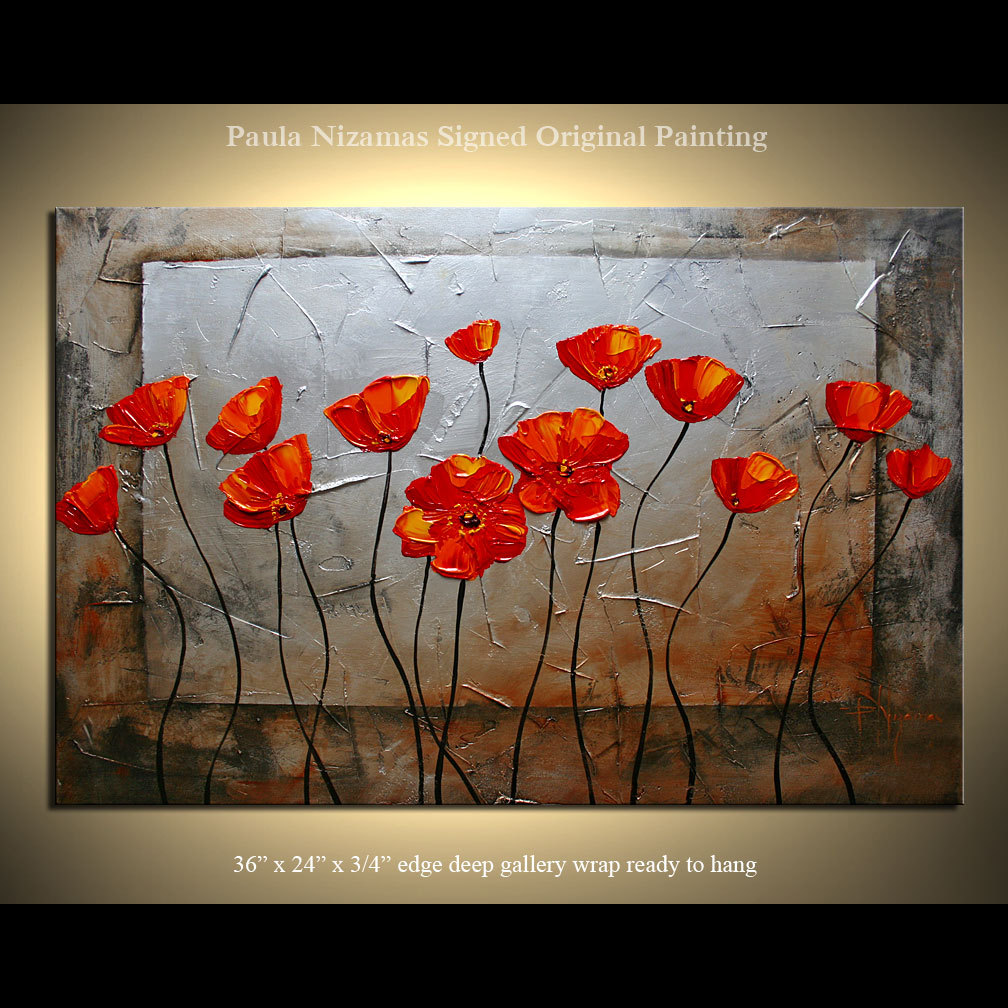
I came across Paula Nizamas and her beautiful paintings and I thought I would share them. I love her works and what captured my attention was the details and warmth in each of her paintings. Her style is very contemporary, full of colour and textures.

About the artist:
Paula Nizamas has worked as a book designer, illustrator and as an artist. In 1999 she earned a Master degree in Fine Arts. In 1985, Paula received her first award for the artwork “Peace” at International Young Artists’ Competition in Moscow. She was also awarded for the artwork “The Crying”, 1st. place, at 54 Gallery So-Ho, NY (International Fine Art Competition).

Since 1996 Paula has worked as an illustrator for book and magazine publishers and as an artist creating paintings, drawings and etchings on stone and zinc. She is also a member of SCBWI (Society of Children’s Book Writers & Illustrators), since 2000.

Please see below a video of Paula Nizamas as well as pictures of some of her works:


If you would like to read more about the artist, please visit www.nizamas.com